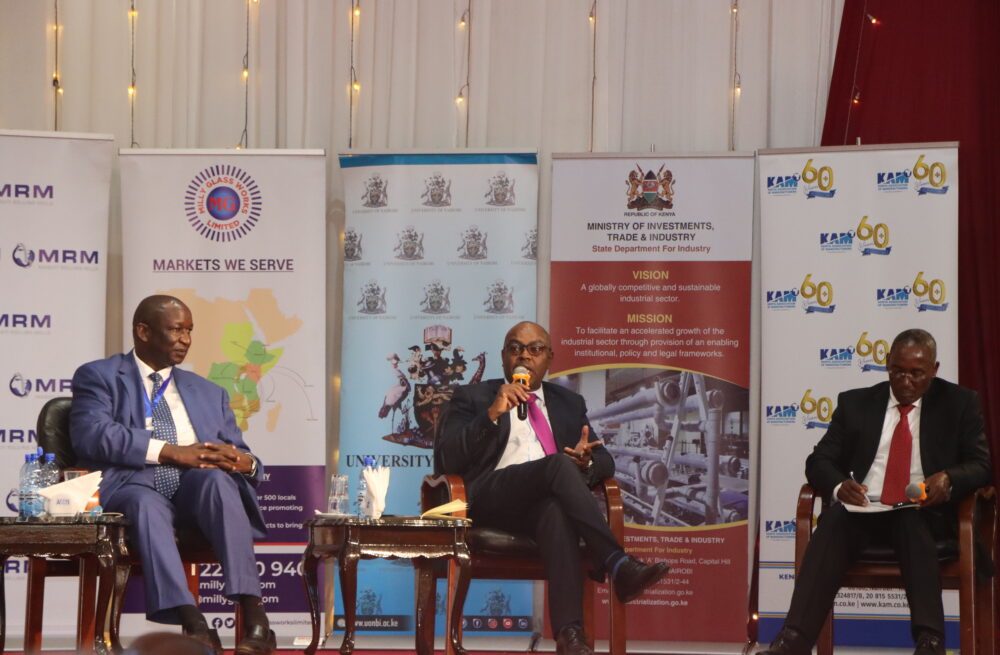
• KAM Chairman Vimal Shah stresses a point during the press conference to announce industry's position on electricity prices.  He's flanked by CEO Betty Maina and KATO Chairman Fred Kaigua among others

    Kenya’s manufacturing sector faces a grim future as a result of the escalating electricity costs in the country.   Consequently, many industries are likely to close and/or relocate to countries with lower production costs of which electricity is a major factor input.

    This emerged this morning as Kenya Association of Manufacturers called on the government to make quick interventions to save the productive sectors of the economy from the negative effects of escalating electricity prices.

    Speaking during a press conference today, KAM Chairman Vimal Shah sounded an alarm over the high cost of electricity in the country, saying prices had increased by approximately 600 per cent over the last one year.

    He said Kenyan manufacturers were paying between Sh10 and Sh15 per kilowatt of electricity; while their competitors in China and India pay the equivalent of between Sh 2.50 and Sh 3.80 per kilowatt of electricity.   This makes their products much cheaper than Kenya’s.

    “With these exorbitant rates, Kenyan industries are now faced with the grim reality of business closures and possible relocations to more competitive countries from where they will produce and export to Kenya,” said Vimal.

    Kenya’s products are increasingly finding it difficult to compete with those from other countries especially Asia, because of the variations in the costs of doing business. Within the Comesa bloc, Kenya’s two major competitors Egypt and South Africa pay minimal electricity costs compared to Kenya.

    He noted that the tremendous increases in energy costs in the country over the past few months have negatively affected the cost of doing business across all sectors of the economy, making Kenya’s products very uncompetitive in the international market.

    “Although high production costs will not stop consumption, consumers will have to choose between buying local products which are more expensive and buying cheaper imported products,” he cautioned, adding that if unchecked, the trend of high production cost is likely to turn Kenya into a trading rather than manufacturing country.

    Chief Executive Betty Maina warned that an estimated 72,000 – 80,000 jobs are likely to be lost due the electricity crisis alone, saying it will further constrain local consumption as purchasing power is lost.

    The Federation of Kenya Employers (FKE) expressed concern over jobs that are likely to be lost and the impact on security.

    The government, said Vimal, should intervene as soon as possible in order to save the country from the current power cost crunch which is posing a major threat to the country’s socio-economic well-being. “We believe that the government is the only entity that holds the key to this crisis that is affecting all Kenyans.” He stated emphatically.

    The director of Alloys Steel Castings Sagoo Tejwany said his factory might be forced to close down within the next one-and-a-half months if nothing is done to curb the current electricity prices. This, he said, would result in approximately 800 workers losing jobs at the factory.

    The chief executive of the Kenya Association of Tour Operators Fred Kaigua warned that the impact of electricity costs on manufacturers will trickle down to the tourism sector because of anticipated rise in commodity prices.

    Also present at the press conference were Kenya Private Sector Alliance (KEPSA) Chairman, Steve Smith, KAM Chief Executive Officer, Betty Maina, KEPSA CEO Sam Mwaura and Kenya Association of Tour Operators Chief Executive, Fred Kaigwa, and the FKE Public Relations and Marketing Manager, Grace Mwendwa among others.


    Recommendations

    During the press conference, manufacturers proposed nine solutions the government could consider to address the high electricity costs:-

    1. Increase investment Generating Capacity: Government should demonstrate by policies and processes that it is doing everything possible to increase generating capacity.  Relying on State provision by KENGEN alone is insufficient. Government should actively encourage other investors from the private sector to participate and explore other sources of thermal energy besides fuel based for example coal.  There are investors that have expressed interest to Government in this regard and but there has been slow response.
    2. Encourage Industries to generate for own use and sell excess to Grid. Beyond the policies thus enacted, Government should actively encourage large consumers to generate electricity for own use and sell excess to the national grid.
    3. Demonstrate Seriousness and commitment to roll out of programmes for Renewable Energy: Government has stated severally its commitment to expansion and adoption of renewable energy generation for example solar and wind. However, there are no significant Government backed programmes to do this. Requirements for all buildings to have solar power installations and exploitation of wind power, would go a long way in reducing the current pressure on existing supplies.
    4. Review Revenue Maximisation Policies:  Government should stop fuelling the inflationary pressure: Government Revenue makes up a significant portion of fuel price at 35%. With a high thermal content in Electricity, Government should cap its revenue collections from fuel used for generation to ease the price consumers pay. This situation is grave for the economy and painful for all consumers. It does not augur well for Government to increase its revenue collection beyond anticipated targets out of such a grave situation.
    5. Incentivise Energy Conservation:  Government should provide Tax incentives and credits for installation of power saving devices at household level and industry.
    6. Review the Financing models used by the utility companies; One of the arguments made by the ERC when announcing the new tariffs in June, was that it would help both KPLC and KENGEN meet the cost of new capital expenditure in systems improvement. However we urge that this model used is revised to reduce initial burden on consumers and spread payout over a longer time span.
    7. Be a Partner to Society in absorbing the pain of high Energy Costs. Government should provide relief to consumers by absorbing some of the additional costs, for instance of rental charges for the emergency power generation. Other charges the Government should pick up include cost of fuel used for Generating Electricity above US$ 70 pb.
    8. Review Programmes for Demand Expansion: there are many government programmes to expand demand for Electricity amid crippling shortages and prices. In order to match promise and delivery, Government should review such programmes.
    9. Demonstrate partnership with Business and Society in finding lasting solutions to the power problem. We as business and other sections of Society have ideas for solutions to the existing challenge. We ask Government to actively partner with all in the search for solutions to this crippling challenge.

    Advertise on KAM